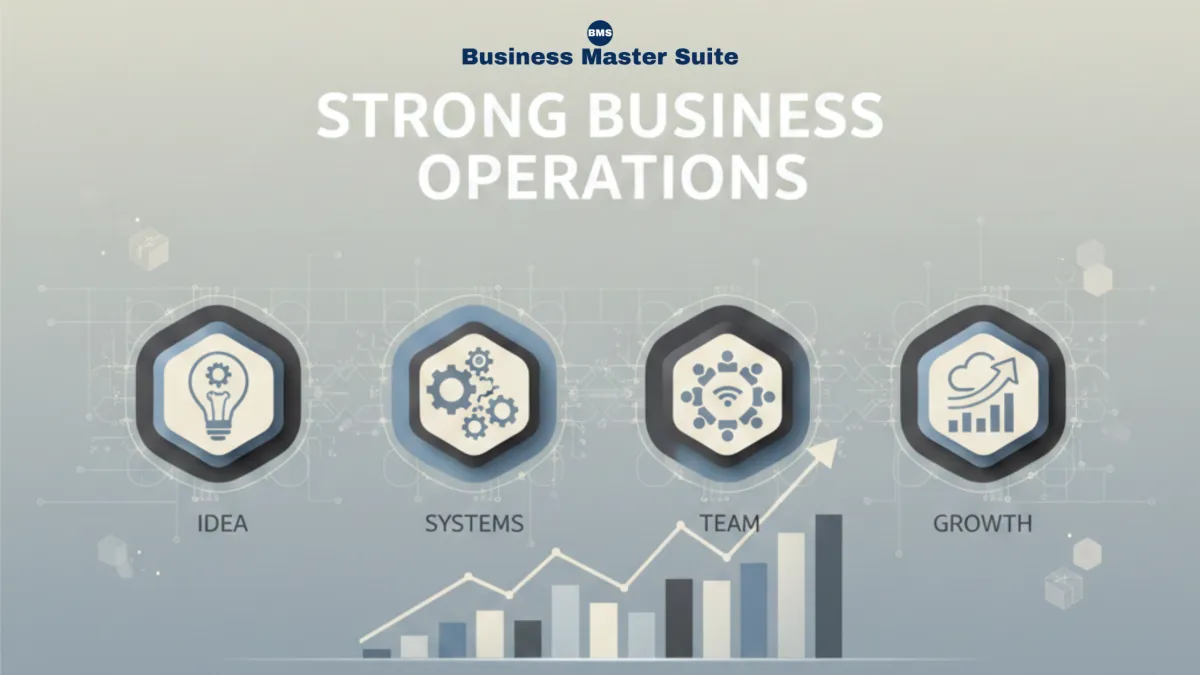
How to Set Up Strong Business Operations at Every Stage of Growth
A practical guide for startups, growing businesses, and scaling companies
Most businesses don’t fail because the idea was bad.
They fail because operations were never built to support growth.
Operations are not just “backend stuff.” They are the systems, processes, tools, and decision-making structures that quietly determine whether your business feels calm or chaotic, profitable or exhausting, scalable or stuck.
The challenge?
What “good operations” look like changes as your business grows.
What works for a startup will break a growing business.
What supports growth will collapse under scale if it isn’t intentionally rebuilt.
This guide walks through how to properly set up your operations at every phase of business growth, so your business can evolve without burning you out in the process.
Phase 1: Startup Operations - Building the Foundation
(0–$10K/month)
At the startup stage, your goal is clarity and consistency, not complexity.
You do not need advanced automation, large teams, or expensive tools.
You do need a clear operational foundation.
What Operations Should Focus on at This Stage
1. Clear Offers & Delivery
If you can’t clearly explain:
What you sell
Who it’s for
What happens after someone buys
Your operations will always feel reactive.
Strong startups define:
A simple offer
A repeatable delivery process
Clear boundaries around scope
2. One Central System of Record
Spreadsheets, inboxes, notes apps, and DMs scattered everywhere create chaos fast.
At this stage, choose one core system to track:
Leads
Customers
Payments
Communication
The goal isn’t perfection, it’s visibility.
3. Manual First, Documented Always
Automation comes later.
Right now, your job is to do the work manually and document it.
Every time you repeat a task, write it down:
How leads are followed up with
How clients are onboarded
How work is delivered
These notes become your first SOPs, and eventually your systems.
The biggest mistake startups make:
Trying to automate chaos instead of clarifying it.
Phase 2: Early Growth - Creating Stability
($10K–$30K/month)
This is where most businesses start feeling overwhelmed.
Revenue is coming in, but:
Everything still runs through the owner
Mistakes are more costly
Time becomes scarce
This phase is about stability and protection.
What Operations Should Focus on at This Stage
1. Replacing Memory With Systems
If your business depends on remembering:
To follow up
To send invoices
To onboard clients
To remind people of appointments
You’re one distraction away from dropped balls.
This is when basic automation matters:
Lead follow-ups
Appointment reminders
Payment confirmations
Task creation
Not fancy, just reliable.
2. Defining Roles (Even If It’s Just You)
Even solo, your business has roles:
Sales
Delivery
Support
Admin
Tech
Separating these mentally (and operationally) helps you identify:
What can be delegated
What needs better systems
Where bottlenecks live
3. Financial Operations Get Serious
You should know:
Monthly revenue
Monthly expenses
Which offers are profitable
Where time vs. money is misaligned
This is often where pricing must change to support sustainability.
The biggest mistake in early growth:
Adding more work instead of strengthening operations.
Phase 3: Scaling Operations - Removing the Owner Bottleneck ($30K–$100K/month)
At this stage, the business is no longer fragile, but it is vulnerable.
Growth exposes every operational weakness.
What Operations Should Focus on at This Stage
1. Process Over Personality
If things only work because you are involved, scale will hurt.
Strong operations mean:
Clear SOPs
Defined workflows
Quality control checkpoints
Your goal is consistency, not heroics.
2. Team Enablement
Hiring doesn’t solve operational problems.
Good systems do.
Teams need:
Clear responsibilities
Defined handoffs
Training documentation
Accountability structures
Operations shift from “doing” to orchestrating.
3. Data & Reporting
Decisions should be based on data, not feelings:
Lead conversion
Show-up rates
Retention
Delivery timelines
Support volume
Operational data tells you where to optimize.
The biggest mistake during scale:
Growing faster than your operations can support.
Phase 4: Maturity & Optimization - Building a Business That Lasts ($100K+/month)
At maturity, operations become a strategic advantage.
This is where businesses move from “successful” to well-run.
What Operations Should Focus on at This Stage
1. Optimization, Not Expansion
Instead of adding:
More offers
More tools
More team
You refine:
Efficiency
Customer experience
Margins
Team performance
2. Leadership & Delegation
Operations shift toward:
Leadership layers
Department ownership
Long-term planning
Risk management
The business can function, and grow, without constant founder involvement.
3. Sustainability
The business should support:
Predictable revenue
Healthy workloads
Clear growth paths
Owner freedom
Operations become the backbone of longevity.
Why Operational Health Matters at Every Stage
Operations aren’t something you “fix later.”
They evolve with your business.
The strongest companies don’t wait for things to break, they intentionally rebuild operations at every growth phase.
Free Resource: Operational Health Check (Companion Download)
If you want a simple way to assess where your business stands right now, we’ve created a free Operational Health Check you can use alongside this guide.
It helps you:
Identify weak points
Understand what stage your operations are in
Prioritize what to fix next
👉 Access the free download guide here.
(Lead info is collected so we can send updates and additional resources.)
If you’re someone who wants to build smarter operations without doing it alone, the Business Masterminds membership exists for that exact reason.
For $20/month, it’s a collaborative space where business owners:
Connect with professionals across business, tech, and operations
Learn how to build systems that actually support growth
Grow alongside others who value structure, clarity, and sustainability
No pressure.
No overwhelm.
Just real conversations and shared expertise.
Sometimes progress isn’t about more information, it’s about being surrounded by people who understand the work.

